Checked: 6 November 2026 — the date every statement on this page was checked against the sources below.
Every producer that puts packaging on the German market registers in LUCID, licenses its household packaging with a dual system and reports its volumes. This page shows how each step works: what counts as packaging, the material types, your weights, the licence and the data reports. A producer with no German establishment also needs an authorised representative named in LUCID, which is a separate page. Sources (2) VerpackDG § 5VerpackDG § 5VerpackDG § 6VerpackDG § 6
The four duties
| Duty | Who does it |
|---|---|
| Register in LUCID | You, online, free |
| Name the authorised representative | You, in LUCID |
| License household packaging with a dual system | We do, in our own name |
| Report volumes in LUCID | We do |
VerpackDG § 5 VerpackDG § 7  ZSVR
What counts as packaging
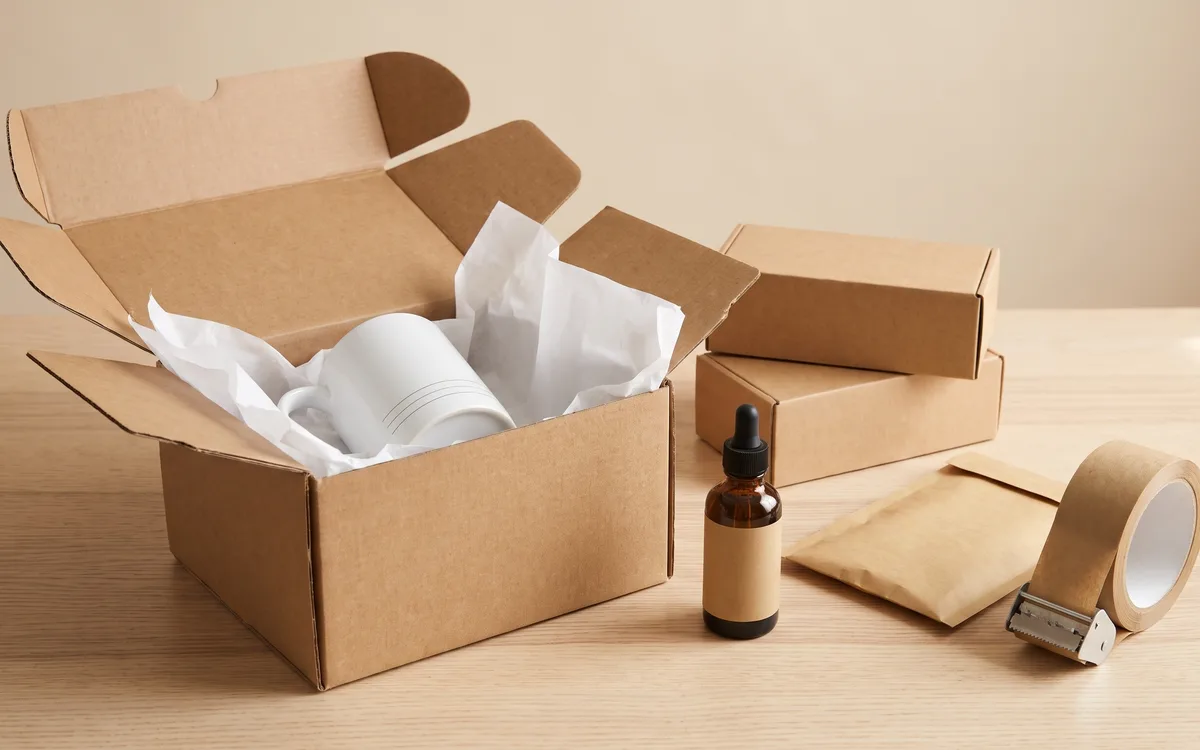
Everything that reaches the end user with your goods: the product box, the shipping carton, filling material, tape, labels and bags. If you send goods to Germany in packaging, you are a producer of that packaging, whatever your size.
Mandatory since 12 August 2026 under § 5 VerpackDG. We are named in LUCID as your representative for €149 a year.
In three steps
- Register in LUCID.
- Work out your packaging by material: an estimate is enough to start.
- License it with a dual system, then report the same quantities in LUCID.
Step by step: LUCID registration, weighing your packaging.
What counts as packaging, item by item
Sellers often ask whether only the shipping box counts, or the bottles and jars inside too. Both count. Under § 3(6) VerpackDG, the dual-system licence covers sales and outer packaging, and transport packaging, that typically ends up as waste in private households or comparable places, plus service packaging. For an online shop that sells to consumers, that is everything in the parcel except the product itself.
| Item | Licensed with a dual system? |
|---|---|
| Product packaging: glass bottles, jars, tins, tubes, product boxes, blister packs | Yes |
| Lids, caps, pumps and closures | Yes, by their own material |
| Shipping carton or mailer bag sent to a consumer | Yes |
| Filling material, tissue paper, tape and shipping labels | Yes |
| Service packaging filled at the point of sale, such as carrier bags or takeaway cups | Yes |
| Pallets, stretch film and cartons that only go to business customers | No. They are registered in LUCID but not licensed with a dual system (see B2B and transport packaging) |
Size does not change the answer. There is no minimum quantity: one parcel a year to a German consumer is enough.
The material types you report
The licence, the data reports and any declaration of completeness all use the same material types, listed in § 42(2) VerpackDG. Any other material is reported as one combined figure (§ 9(1)).
| Material type | Typical items |
|---|---|
| Glass | Bottles, jars |
| Paper, board and carton | Shipping cartons, product boxes, paper filling, paper labels |
| Ferrous metals | Tinplate cans, steel lids |
| Aluminium | Cans, foil, tubes |
| Beverage cartons | Cartons for drinks |
| Other composites | Packaging made of several materials bonded together |
| Plastics | Mailer bags, bubble wrap, tape, bottles, pots, films |
| Other materials | Wood, textile, ceramics: one combined figure |
How to get your weights
- List every packaging component of each product and each parcel type: the jar, its lid, the label, the box, the filling, the tape.
- Weigh each component empty, or take the weight from your supplier's specification.
- Multiply by the number of units you ship to Germany in the year.
- Add the results up per material type.
An estimate is enough to start. If the real figures turn out different, the participation and the data report are updated: § 9(1) VerpackDG requires changes to be reported to ZSVR as well. Step by step: weighing your packaging.
Dual systems: what they are and how the licence works
A dual system is a private organisation for producer responsibility, approved under § 20 VerpackDG, that collects and recycles household packaging across Germany. Before you make packaging available, you take part in one or more systems with that packaging, stating the material types, the weights and your LUCID registration number. The system confirms the participation in writing or electronically (§ 7(1)).
- You can choose any approved system; the price is set per kilogram and material type by each system, often with a minimum fee for small quantities.
- As your authorised representative we conclude the participation in our own name (§ 5(3)) and pass the system's price on at cost, with no markup.
- Packaging that was damaged or could not be sold and that you took back and had recycled can be refunded by the system (§ 7(3)).
Compare the operators: dual systems in Germany and licence rates.
VerpackDG § 3 VerpackDG § 5 VerpackDG § 7 VerpackDG § 20
How reporting works
| Filing | When | Content |
|---|---|---|
| Participation with a dual system (§ 7) | Before the packaging is made available in Germany | Material types, weights, LUCID number |
| Data report to ZSVR in LUCID (§ 9(1)) | Without delay after each participation | LUCID number, material types and weights, the system's name and the period |
| Data report for small producers (§ 9(2)) | Under 10 tonnes in the previous year: once, by 1 June of the following year | The same items, for the whole year |
| Declaration of completeness (§ 10) | By 15 May, only from 80 t of glass, 50 t of paper, board and carton, or 30 t of the other material types a year | All packaging of the previous year, checked by a registered expert or auditor |
ZSVR compares what you report with what the system reports. We file the participation and the data reports for you; the figures come from you.
VerpackDG § 7 VerpackDG § 9 VerpackDG § 10
An example: a small online shop
A hypothetical shop, not a client, that sends 30 parcels a year to German consumers. Each parcel holds two glass jars with steel lids in a cardboard box, with paper filling and a plastic tape.
| Component | Per parcel | Material type | 30 parcels |
|---|---|---|---|
| 2 glass jars | 400 g | Glass | 12 kg |
| 2 steel lids | 20 g | Ferrous metals | 0.6 kg |
| Box and paper filling | 320 g | Paper, board and carton | 9.6 kg |
| Tape | 5 g | Plastics | 0.15 kg |
That is about 22 kg a year. The shop licenses these four figures with a dual system, usually at the system's minimum fee, files one data report a year as a small producer, and needs no declaration of completeness.
From producer test to licence: the order of the steps
- Producer test: you first make packaging filled with goods available to German end users.
- Your LUCID registration, in your own name, with every brand you sell under.
- Mandate and naming: you sign our German mandate and name us in LUCID.
- Licence: we take out the dual-system participation for your household packaging.
- Reports: data reports to ZSVR, and the declaration of completeness if your volumes require one.
The representation and the licence are two layers: our fee is €149 a year; the dual system charges its own rate for your weights, passed on at cost.
Declaration of completeness: what we file and what an expert checks
§ 10 VerpackDG requires a declaration of completeness only above the thresholds in that section, or when an authority asks for one. It must be checked by a registered expert or auditor and filed with ZSVR by 15 May for the previous year. As representative we prepare and file it from your figures; the independent check is done by the registered expert, whose fee is separate. See the thresholds.
Razvan Toma is the founder of EPR Germany Rep and of EPR France Rep, the French sister service. He has worked in waste management and recycling since 2009, running circular economy programmes inside large B2B organisations in France for clients including Chanel, Microsoft, Decathlon, Pirelli, IKEA, Vinci, Capgemini and E.Leclerc. He reads the statutes and the regulator's own guidance directly, and publishes what they say — including when it means telling a visitor they do not need to buy anything.
Razvan on LinkedIn ↗